inquiry: transness & me
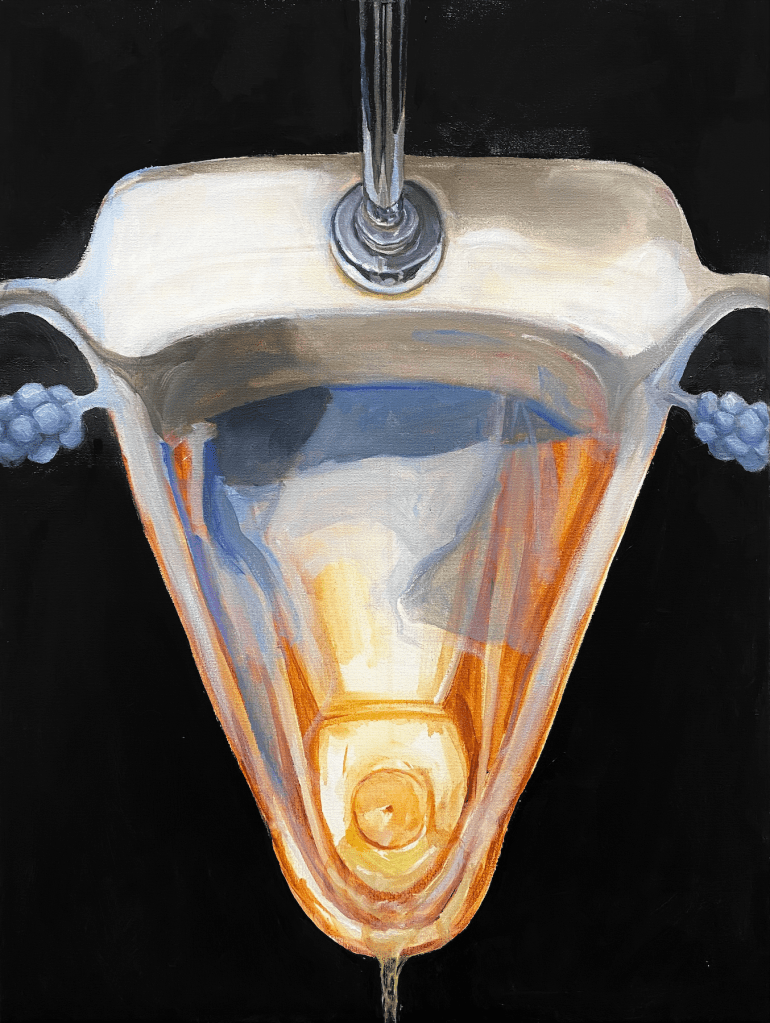
sites of bodily disposal
Sites of Bodily Disposal is a water-based oil painting of a urinal that also resembles the female reproductive system, with fallopian tubes and ovaries blending into the porcelain structure. A vivid blue gradually envelopes the raw underpainting of the urinal, and a trickle of urine leaks out the bottom, where it has pooled up. This painting is a commentary on feminine bodily autonomy, as well as the sexism and gendered violence experienced by women around the world.
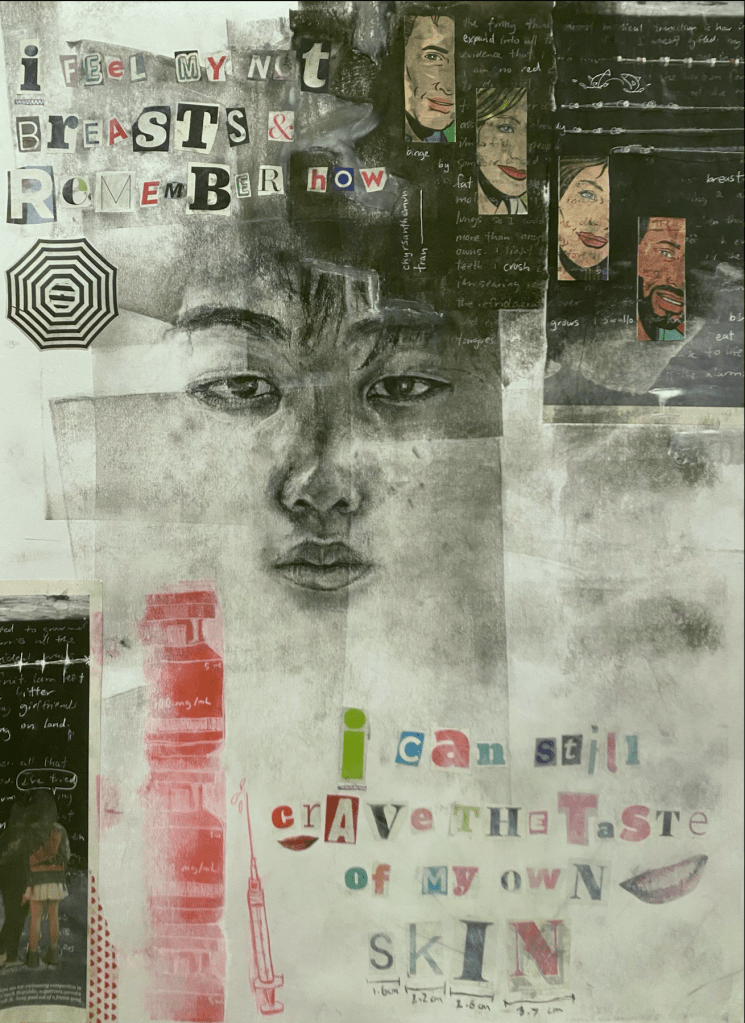
binge
Binge is inspired by a poem of the same name, written by transgender poet Chrysanthemum Tran. Excerpts of her poem are scribbled in white onto the dark corners of the piece, fading in and out with a few points of intensity, as well as the almost imperceptible space between the vials of testosterone---rolled onto the paper with printmaking methods and carved out with colored pencil---and collage. The words "I grow" is smudged away on the right hand side. The final sentence of her poem is cut out of magazines letter-by-letter and brackets a self-portrait of myself, layered with geometric shapes. Additional details include the red lipstick on each character and lane ropes crafted through thin strings, knotted on the left to form buoys. I wanted this piece to be visually interesting and to challenge myself with using as many mediums as possible; my ultimate goal was for the viewer to linger, to spend time searching for all of the small details that can only be uncovered with close observation. The complexity, discordance, and chaos reflect my experience with gender as a transgender teenager.
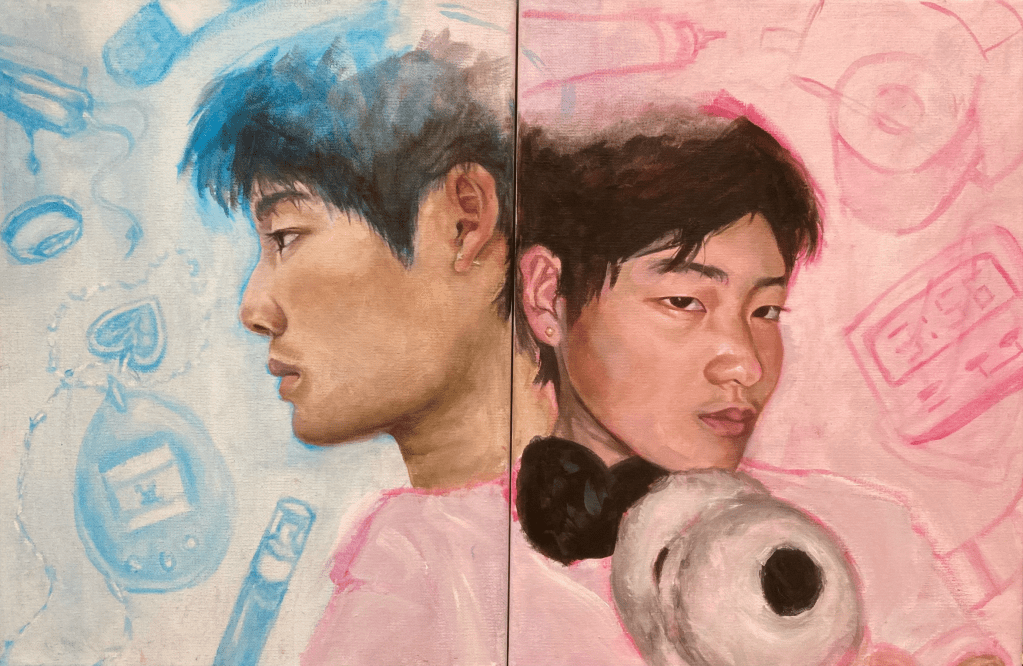
gender reveal party
Gender Reveal Party is a water-based oil painting and a self-portrait, strewn across two canvases. It explores my personal relationship with my gender as a transgender person by undermining the stereotypical, gender-aligning pink and blue backgrounds with unconventional objects. I ask the question: why must gender be represented by a dress or a tie? Why can't my gender be linked to objects that feel affirming to me and give me joy? Through various floating possessions---a masculine perfume, which inspires my confidence; my stopwatch, used when I debate competitively through a transgender lens; the binder and tape that help me feel comfortable in my own body---I illustrate my own unique transness.
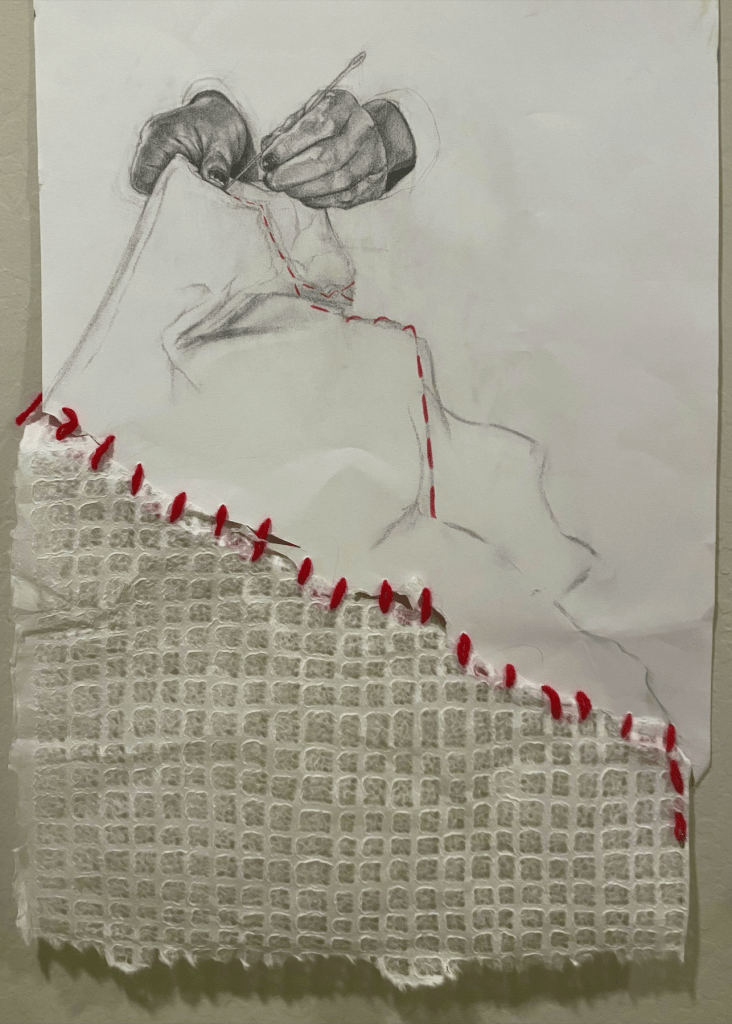
A Network of care
A Network of Care reflects the beginning of my journey in chasing gender-affirming care and how my transgender friends came together to care for me. Because of my chest dysphoria, I desired a binder; however, access was difficult due to my transphobic family. One of my transgender friends gifted me his old binder, but it was ripped at the seams from wear-and-tear. Another trans friend, who is talented in sewing, was able to patch it up for me: an act that this piece illustrates through both the graphite drawing of a set of hands sewing and the red yarn---needle still attached at the end---threaded through the two pieces of paper, resembling stitches. The flowing, never-ending, blurred fabric of the binder represents the fluidity of transness, and the red lines drawn in colored pencil mirror the road that I took in my journey. Additionally, the net-like texture of the bottom piece of paper symbolizes this network of care and the way that my community acts as a safety net for me.
overkill
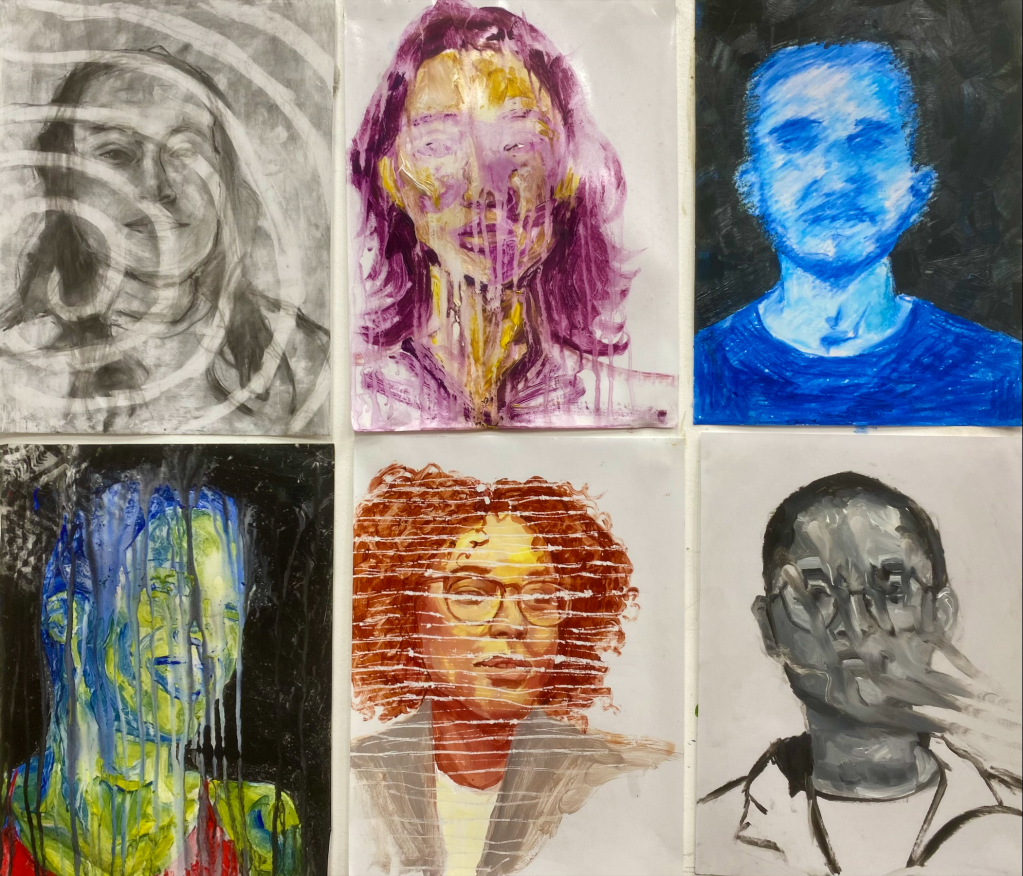
Overkill is my attempt to visualize Eric A. Stanley's ontological and structural claims in their book The Atmospheres of Violence: Structuring Antagonism and the Trans/Queer Ungovernable. They explore how anti-trans violence comes to be and operates within society, with one manifestation of this "atmosphere of violence" being "overkill." Overkill is "such excessive violence it pushes a body beyond death"; in other words, it is not only the intentional murder of transgender people, but the attempt to erase all traces of transness altogether. I began the process by tenderly and lovingly creating portraits of transgender people on palette paper using a variety of mediums: acrylic paint, water-based oil paint, charcoal, and gel sticks. I ensured that I was diverse in my subjects and that none of them looked "stereotypically trans," as there is no "look" that indicates transness. I then began the process of not only "killing" them, but disfiguring them beyond recognition. This included literal erasure with an eraser, wetting paints with a spray bottle, scraping them with a palette knife, stepping on them, and using my own fingers to smear their face in an intimate act of murder. It was painful not only because I put a lot of time and effort into making them look well-rendered, but because I consciously knew what this destruction paralleled in real life. The disturbing nature of this series is what makes it accurate to my own and other transgender people's experiences.
webs of surveillance
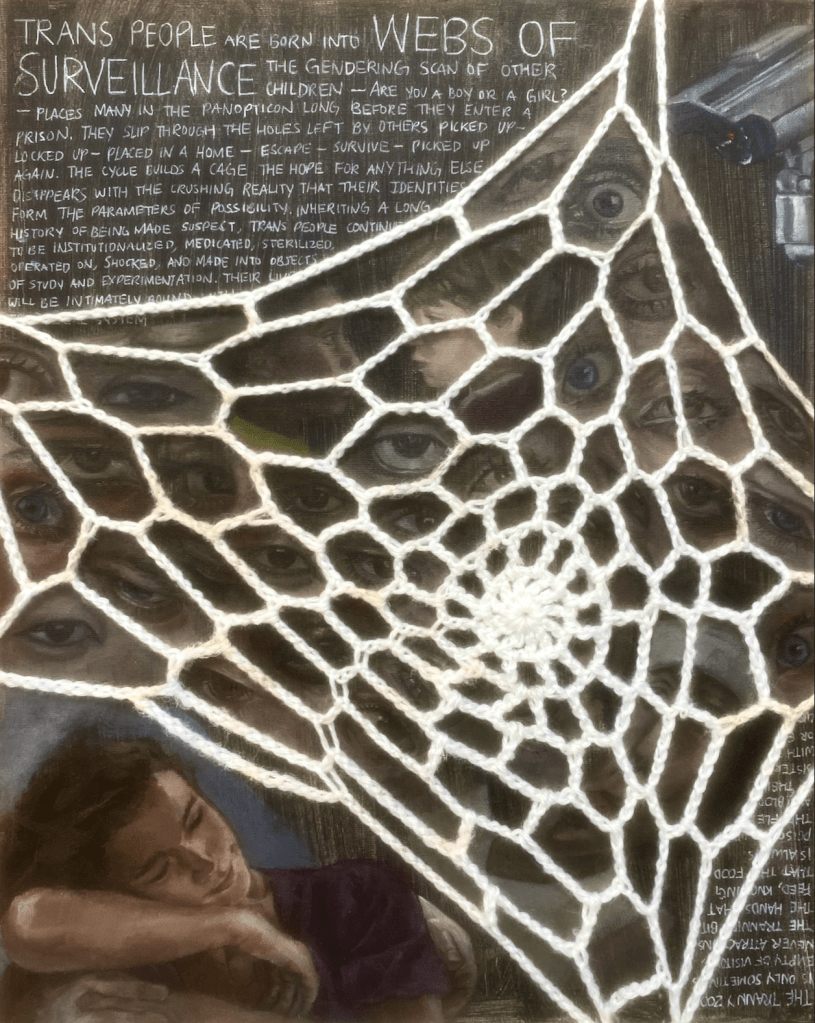
Webs of surveillance critiques the mass surveillance of trans people and the prison industrial complex using an excerpt from eric a. stanley's introduction in captive genders: trans embodiment and the prison industrial complex (text on the top, written in white gel). it also features an excerpt of zoo visit on the bottom:
THE TRANNY ZOO IS ONLY SOMETIMES EMPTY OF VISITORS
NEVER ATTRACTIONS
THE TRANNIES BITE THE HANDS THAT FEED
KNOWING THAT THE FOOD IS ALWAYS POISONED
WITH THE FLESH AND BLOOD OF THEIR SISTERS
WITH T OR E OR…
Water-based oil paint depicts eyes, most of which gaze directly at the viewer, emitting a feeling of being "watched." the viewer may, however, feel a sense of security because they are trapped behind a physical crochet web. the kids conversing represent the "gendering scan of other children" and the woman at the bottom, being caressed by an unknown hand, sheds a glimmer of hope for trans intimacy despite the gratuitous violence we face.
AUTOMATED DESIRE
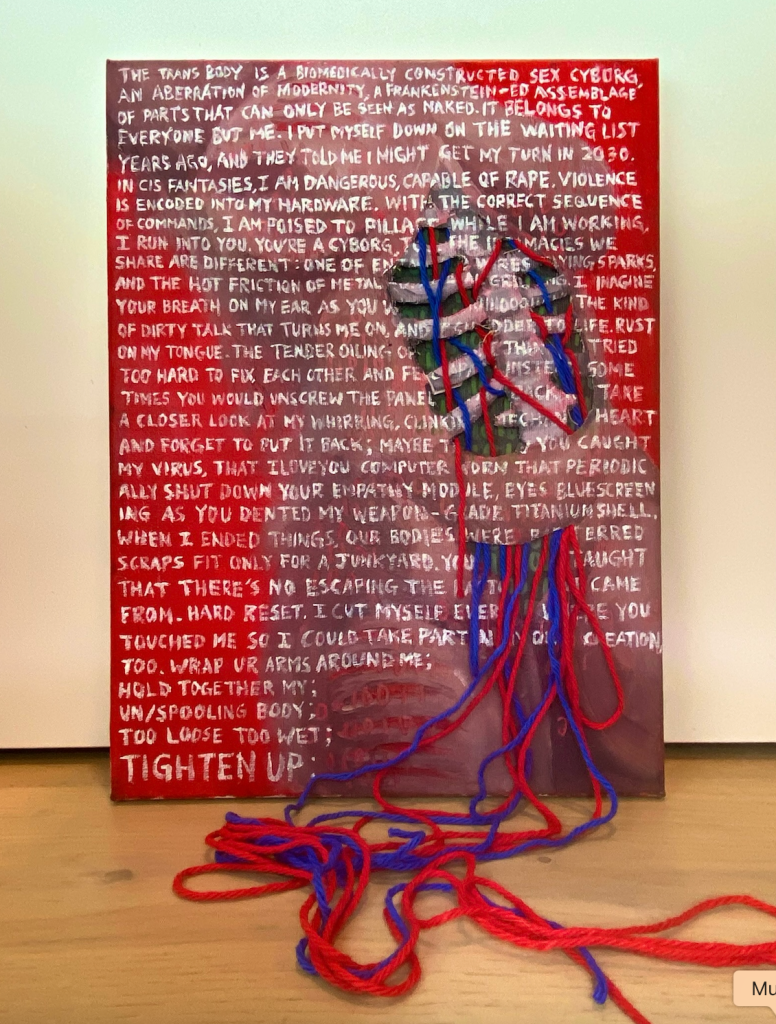
text from automated desire.
wake up trannies!
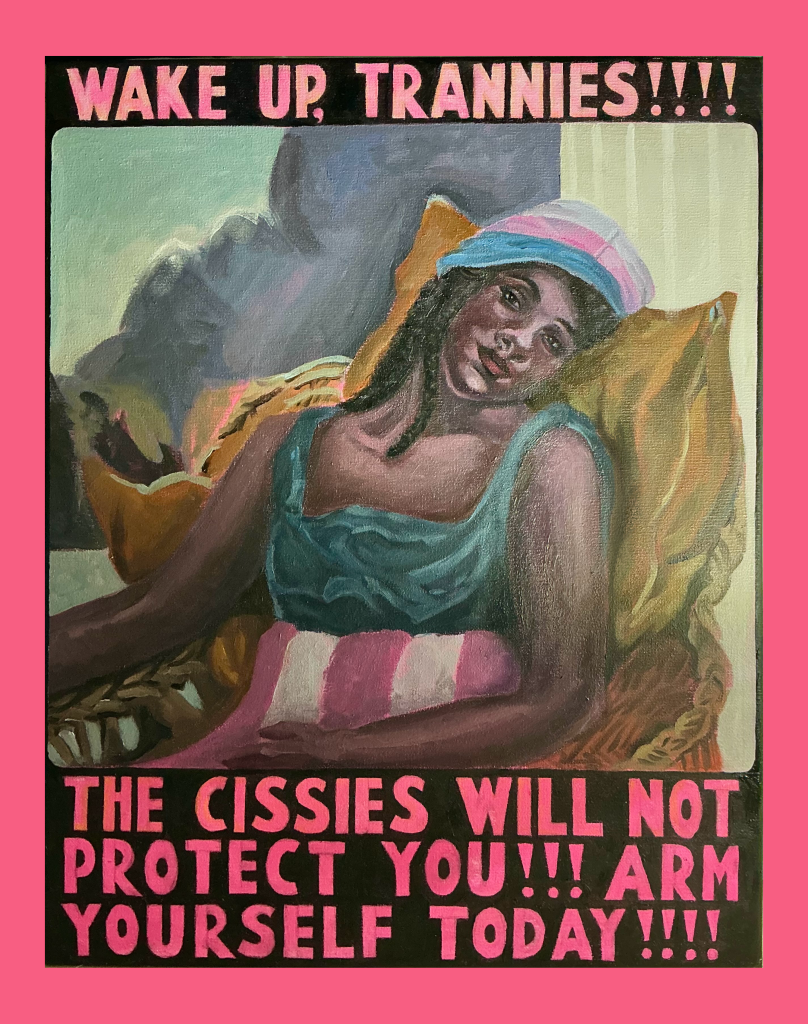
re-propagandizing the "wake up america!" propaganda poster from world war I
 crow's poetry blog