tosiek irl on twitter, 10:43 PM · Mar 5, 2025:
"talking to chloé about how 'tranny' is my gender AND sexuality, more than genderqueer or male or transgender or bisexual or arospec or any other label, because tranny is embracing abjection, proudly being a freak and a social aberration, rather a condition defined by the existence of normalcy as transgender is; e.g. in order to render coherent transness the cisgender, the correct bioessentialist state, must exist first; there the trans/cis dialectic is a reterritorialization of money’s invented gender and predicated upon transgenderism as a pathologized, curable mental disease. we are categorizing and restaticizing ourselves in a way that opens ourselves up to co-option, instead of being unintelligible and constantly mutating. to be a tranny is to refuse category, to be so disgusting that cissies cannot conceptualize you. there is no boundary to being a tranny, no set definition, just a mass of energy and feeling. anyone can be a tranny. they thus make an enemy of that which is nothing."*
*to preface this: if you're cis, i do not give a shit on whether or not you think the tea-slur can be reclaimed by trans people. you also should not be saying it. i am also of the opinion that trans people who are TME (transmisogyny excluded) can reclaim "tranny" in particular, and although i obviously do not use TMA-specific (transmisogyny affected) slurs like "trap" or "troon" for myself, i do think that we can say them in discussion. it is still important to recognize that "tranny" is disproportionately used against trans women. i also think that you have to be culturally trans to a certain extent before the act of reclaiming "tranny" becomes meaningful for you; not all trans people can be trannies in a productive way (such as assimilationists or those still clinging onto their cis privilege). 100% open to debates or critiques on this btw.
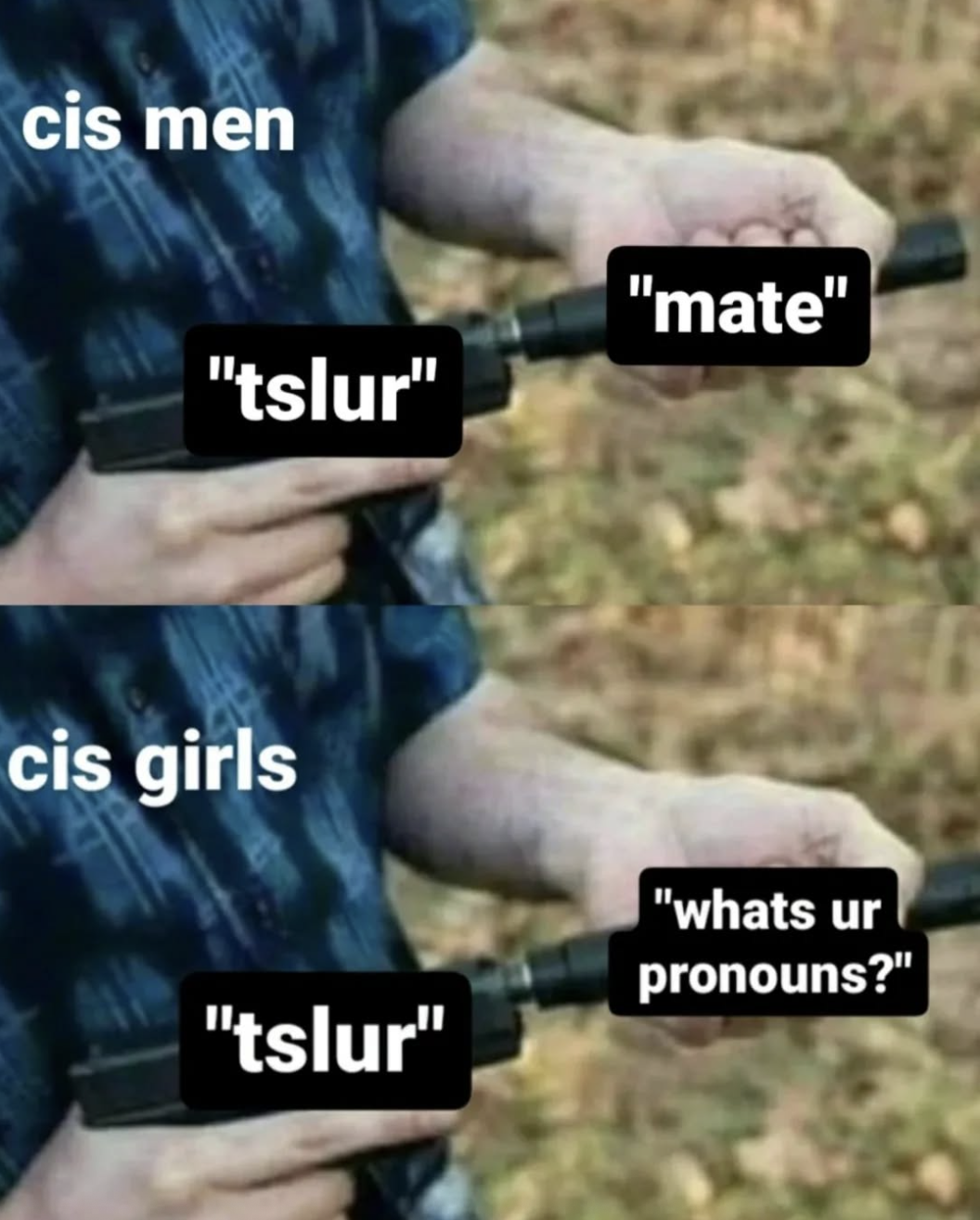
gender & me
my own transition process was a decategorization that, to me, feels like liberation. my first queer self-label was "bisexual," which i announced to everyone at the four-square court in fourth grade. i then gendered myself as genderfluid, before specifying that i am genderflux. "transgender" was a background label for me; technically i was trans by definition, but i didn't call myself that. thus began a process of self-identification, in which i jumped between labels routinely in a desperate attempt to figure out who i am. i recorded my progression of labels all throughout highschool, from the summer before freshman year:
before summer: biromantic lithromantic aroace; genderfluid (ze/he/she)
after summer: aromantic bisexual; transgender & genderfluid (ze/he/she)
12/3/22: aromantic (queerplatonic) bisexual; agender & genderfluid (ze/he/she/they)
5/7/23: aromantic bisexual; transgender (he/him)
5/28/23: arospec bi, transmasc (he/him)
7/21/23: arospec bi, transmasc (he/him)
10/18/23: aromantic bisexual, transgender + genderqueer (he/him)
12/3/23: bisexual, arospec, trans, genderqueer (he/him)
5/2/25: genderfucked transfag he/zir
today: queer transsexual
all of this is still true (minus being asexual lol. discovered that i am definitely not asexual). if you forced me to label myself with as much detail as i could, i would begrudgingly claim the identities of arospec, bisexual, transmasc, genderfluid, and genderflux, but it would be uncomfortable for me. today, i identify most with the broad categories of "queer" and "trans." i sometimes specify that i am genderpunk/genderfuck/genderqueer to distinguish my transness from binary trans people, but that's as far as it goes. i tell people my pronouns are he/him, but my heart's not really in it.
tosiek irl on twitter, 5:27 PM · Feb 27, 2025:

everyone's experience with gender and labels is unique and different. that's probably the most important thing to remember about trans people: there is no one "transgender experience." labels, especially microlabels, can help build a community of kin and shared experience. it can also help you feel comfortable with the way you move through the world, though i argue that we are conditioned to find this comfort by the empire (will explain this more later).

personally, i find labels limiting. i don't like that there's a set definition to each one that you could find in a dictionary or wiki page. i once had a cis person who was attracted to me tell me that he was still heterosexual because my sex "is still female." even definitions that have evolved to be more inclusive—such as lesbian being defined as "non men loving non men" in an attempt to include nonbinary people, or "heterosexual" defined by gender—do not capture the complexity of human gender and sexuality. specific labels also cannot keep with the constant ebb-and-flow of my gender.

to categorize myself is to make myself digestible, comprehensible, understood. it's to fix myself into place, to force myself to stay still for long enough to pick out exactly "which way i swing." to dig deep into my psyche; to give cis people the opportunity to wrap their heads around me. it's to ignore that categorization is a colonial tool used for surveillance and biopolitical management; to write us into violent laws. it's tiring, and i'm at a point where i just don't care anymore. i'm attracted to whoever i'm attracted to. i'll present however i want to. and tbh? my gender is none of your business. trans people don't owe you coherency.
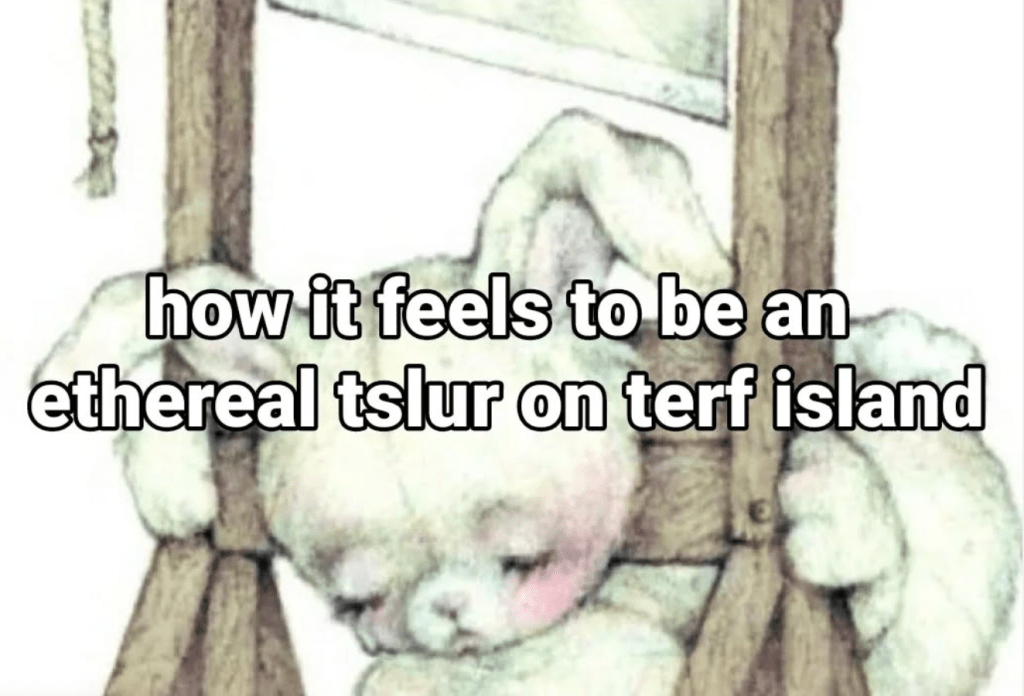
abjection
according to robert phillips, "Abjection refers to the vague sense of horror that permeates the boundary between the self and the other. In a broader sense, the term refers to the process by which identificatory regimes exclude subjects that they render unintelligible or beyond classification." he goes on to explain this concept in direct relation to transness:
Abjection, as Kristeva describes it, “disturbs identity, system, order” (ibid.) and encompasses a kind of borderline uncertainty—ambiguous, horrifying, and polluting. Transgendered bodies, then, especially when viewed as physical bodies in transition, defy the borders of systemic order by refusing to adhere to clear definitions of sex and gender. The abject can thus serve as a cleaving point of abstruseness and unease—separating, pathologizing, and psychologizing trans subjectivity. The anxiety at the root of this unease with transgender subjectivity can be traced back, in part, to a fear of the ambiguous.1
i argue that if transness will always be demarcated within the empire, it is far more productive to embrace our positionality than to reject it and chase assimilation. yes, i’m aware that this sounds exactly like edelman’s death drive2 argument, but i’m not talking about reproductive futurity. it is important to note that “transgenderism” is an invention, just as sex as a medical, biological category is. john money invented “gender” once the emergence of intersex people destabilized traditional preconceptions of sex; “transgenderism” was then invented by henry benjamin as gender deviant bodies began to violate those categories as well. in this sense, transness cannot exist without cisness, as it is defined as being “outside of cis norms.” since then, the binaries of “transgender vs cisgender” have replaced the old “male vs female.” transgender replaces gender; gender replaces sex; sex is invented. this is obvious in our current political sphere, where trannies and cissies are constantly being pitted against each other. every day, you hear news about a trans athlete “robbing” cis girls from their medals, or drag queens “indoctrinating” your kids into mutilating themselves. mainstream queer organizations have dropped the “t,” calling themselves “lgb” advocates. trans people are specifically not allowed to enlist in the military (thank god. not mad about this). gender-affirming healthcare is only legal for cis people in certain states. gender dysphoria, and thus transgenderism, is listed as a mental illness in the DSM-5.
once you categorize yourself as trans, you are doing work for the empire and placing a target on your back. all of a sudden, a web of legislature containing the keyword "transgender" applies to you. i'm not saying that you shouldn't identify as trans—hell, i'm loud as fuck about being trans myself—but i do think it's an unfortunate reality.
tosiek irl on twitter, 10:48 PM · Mar 5, 2025:


the tea-slur as a tool
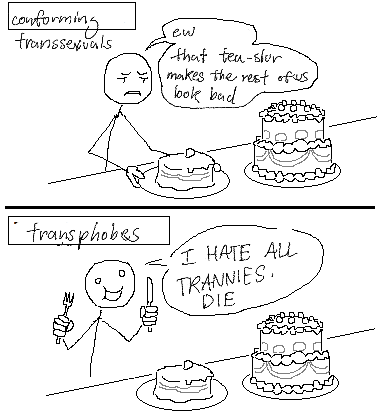
back to the main focus of this post: i believe that trans people reclaiming the t-slur is not only empowering, but also a weapon for survival. the goal of many trans people, especially binary trans people, is to fully assimilate into cisheteronormative culture; to "pass." many hope that as long as they act "normal" enough (ditch the pride flags, stay quiet, dress like they're "supposed" to, get all of the "required" medical procedures, etc.) they will be accepted by the empire. they shun trans people who refuse to do so, like neopronoun users, who are mocked and told that they're the reason why cis people will never take transsexuals seriously. unfortunately, this strategy doesn't work out for them. the privilege that they gain can be revoked at any time. it doesn't matter how much you dickride cissies or the government; it hates you and wants you dead. it's like that one cake meme:

edited to show what i mean:
so, how do we avoid co-option? tranny is a slur. obviously. used by cis people to shit on trans people, especially trans women, who "don't pass" according to their standards. it is pre-charged with the underlying message that cissies hate trannies; it is their idea of someone so far outside the confines of gender that it renders them disgusting. in other words: transgender final boss. i think that we should move towards that ideal and become the tranny that they fear so much. embrace abjection. refuse category. be disgusting. take it from phillips:
In this sense the notion of embracing abjection is epitomized by Susan Stryker’s essay ‘‘My Words to Victor Frankenstein above the Village of Chamounix: Performing Transgender Rage’’ (1994), in which she connects her own transsexual body with the figure of Frankenstein’s monster. Stryker acknowledges and welcomes her abjection when she declares, ‘‘I am a transsexual, and therefore I am a monster’’ (240). Through this declaration, she is reclaiming the word monster in order to relieve it of its power; but more importantly, abjection becomes a tool with which to further challenge and problematize conventions of socially constructed gender categories.
it also helps that tranny is not a set category, but rather a constantly shifting adjective that can be applied to anyone. it's not clockable. not all trans people are trannies, and not all trannies are trans. there is power derived from its usage as a slur; transphobes hurl it towards anyone gender non-conforming, including cis people who crossdress, perform in drag, or simply defy gender roles by painting their nails or being a stay-at-home dad as a man. this explodes the boundaries of transgenderism, opening the potential to move towards something beyond gender. it is difficult to fight something that doesn't exist.
 crow's poetry blog
Leave a comment